Archive for the ‘ business ’ Category

UC Berkeley Executive Education : Product Management

Recently I attended a Product Management session put on by the UC Berkeley Center for Executive Education in Santa Clara, California.
In this post I am not going to catalogue all that was talked about or even cover the bullet points of each day. In this post I am going to give an overview of my personal takeaways and what I want to apply to my career and team. In other words, if you were hoping that by reading this post you could skip attending the session yourself, you will most likely be disappointed.

Takeaway #1 : Analyze and Adapt
This takeaway is really an approach that permeates the entire philosophy taught during the week.
The very first day they start off with an outdated PowerPoint SmartArt chart with the three layers titled: Sensing, Seizing, Transforming. This three pillar approach covers all steps of analyzing your current business (product, market, consumer, …) and/or the business you hope to enter and then helps you adapt your business in order to capitalize on new opportunities, and finally to set up your business to be able to sustain the new business.

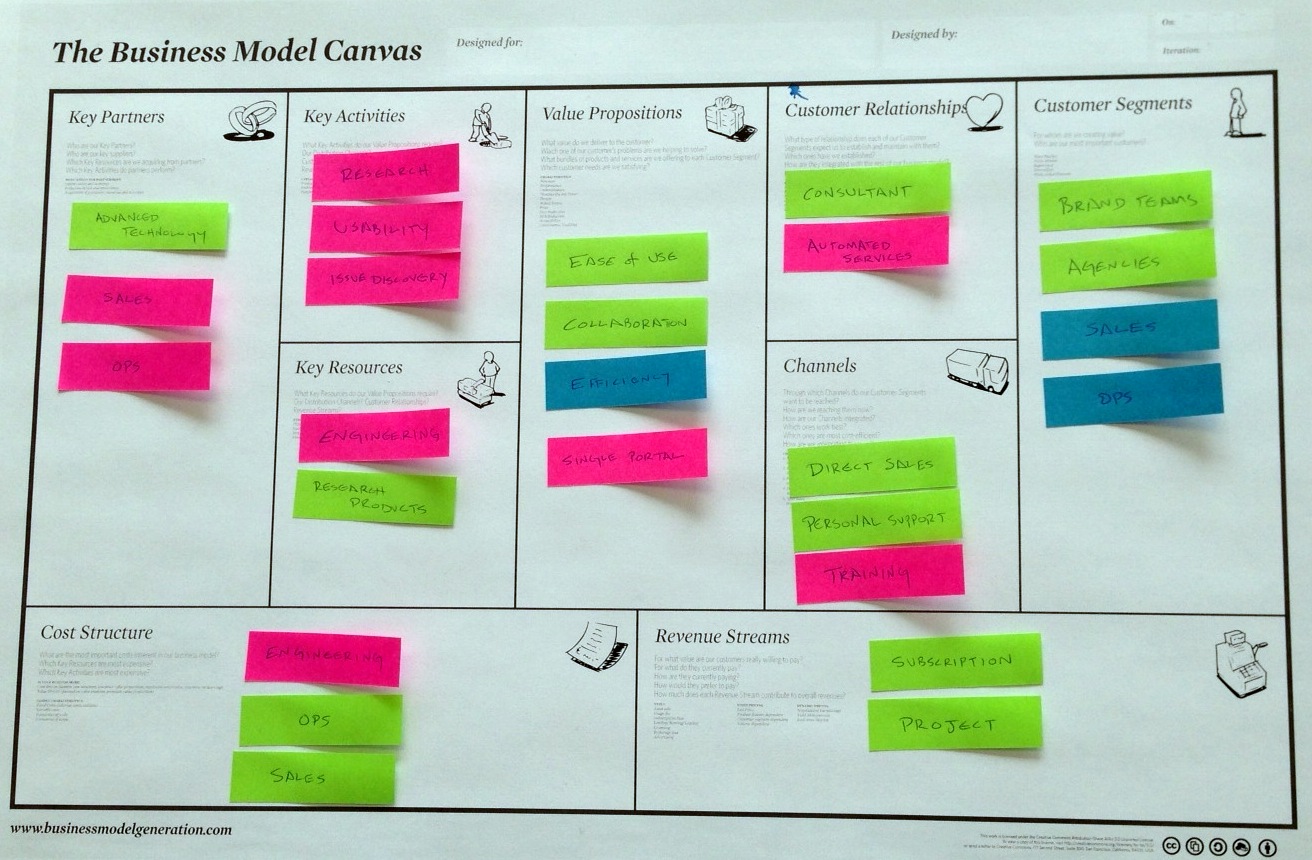
The primary tool they provide to Analyze and Adapt is the Business Model Canvas. This canvas, available at businessmodelgeneration.com, is a pre-structured visual tool for defining and exploring your business model. There is also a fancy book, perhaps too fancy for its own good, which will explain the Business Model Canvas (BMC) in tremendous detail.

Here is the BMC I cooked up after I returned home (I’m not revealing any trade secrets by sharing this):
Business Model Canvas

The Good of the Business Model Canvas:
The BMC provides a means to pretty easily talk about your business both to yourself and others. When done with colors you can quickly see where segments should be treated as one or are under-served. You could even go into exacting detail on each of the ‘post-its’ to attempt to calculate the effect of each item on your business. I found that the BMC helped my realize key partners that I wasn’t necessarily treating like key partners.

The Bad of the Business Model Canvas:
Mostly the bad revolves around frequency of use. They suggest keeping a copy of your business model canvas on a wall all the time (which I have done) in order to reference and play around with it. In reality though, how often are you going to change your business model? Once or twice a year seems pretty aggressive to me. With that frequency of use in mind, the stickiness of such tools like the BMC are dramatically reduced.
Like any formulaic approach to tackling all of the world’s problems there are exceptions and grey areas. The BMC has these. It took me a while to accept that I could alter the structure of the canvas, but you can. You can combine “Customer Relationships” and “Channels” for example if that seems to fit your business better.

Outside of the Business Model Canvas other topics were covered which fall under the Analyze and Adapt category. One of such topics was a company’s Core Values. In order for a company to sustain innovation and profitability a company must possess the following Core Values of Corporate Innovation:

  • Questioning is consistently encouraged
  • Risk Taking is in the DNA
  • Openness is rewarded
  • Patience is practiced, by all
  • Trust is demonstrated throughout
    • “Trust is built when something of value is put at risk”

Takeaway #2 : Communication is Key
Communication cannot be underestimated as the primary skill of any Product Manager. Problem solving, innovation, project management, and other skills can be delegated or off-loaded if needed, but communication is what enables a Product Manager to coordinate releases, facilitate meetings, inform stakeholders, persuade leadership, and define features.
Internally, there are many ways to communicate but the best way to communicate with your user is to get out of the office. Which brings us to Takeaway #3.

Takeaway #3 : Get Out of the Office
The best way to get into the Heads, Hearts, and Hands of your current and prospective consumers is to get out of the office and meet them. Talk with them, observe their behaviors, dig deep into their motives.
There are three Levels of understanding the customer – Use, Usability, and Meaning.

  • Use can be describes as the basic functionality of a product.
  • Usability represents aspects of a product that give the user access to the use.
  • Meaning is comprised of the user’s ultimate needs and motives as well as the perceived value, usually non-monetary, of a product.

Innovating on meaning can have the biggest impact.

Those are my three main takeaways from the UC Berkeley Product Management sessions.

Below are the topics that receive Honorable mention:
Pricing

  • “Capture Value” that is Created and Delivered by the rest of the Business Model
  • “Innovate for Growth, Price for Profitability”

Peer Coach

  • A person outside your company with whom you meet once a month to talk about business problems faced by each. Talk for one hour about one person’s issues and then talk for an hour about the other’s.

Open Discussion: The Definition of Agile

This morning I sent an email to my development and QA team leads. It was a response to a discussion we had all had a couple weeks ago about the definition of Agile Software Development and whether my plan for next year (2013) was more Agile than our current approach. Below is the bulk of the email.

——

The phrase I’d like to call out in particular, from the wikipedia definition, is “a time-boxed iterative approach”.

From Wikipedia
Agile software development is a group of software development methods based on iterative and incremental development, where requirements and solutions evolve through collaboration between self-organizing, cross-functional teams. It promotes adaptive planning, evolutionary development and delivery, a time-boxed iterative approach, and encourages rapid and flexible response to change. It is a conceptual framework that promotes foreseen interactions throughout the development cycle. The Agile Manifesto[1] introduced the term in 2001.

My personal definition of Agile Software Development, as it applies to my current position, involves the following steps:

  1. Discover and define a problem or opportunity
  2. Define and design a UI for the minimum set of features to address the issue from #1
  3. Determine the amount of time worth spending on implementing #2 (At this point, if effort greatly outweighs value, either the problem/op or solution need to be reconsidered.)
  4. Code-design and implement with the intention to produce simple, high quality, working code in as little time as possible
  5. Release and monitor
  6. React and iterate

Between each step there are, of course, discussions held, adjustments made, and iterations on what is the “current truth”.

I would like to remind us all of our goal to be agile and let us cross detail-bridges as they come while planning for future known-bridges.

——

In Conclusion: Being Agile is more fun and rewarding than being NOT Agile.

37 Signals

“Scope down. It’s better to make half a product than a half-assed product.”

Meeting Facilitation

Sounds boring doesn’t it, but it is rather interesting even if you don’t have to run as many meetings as I do.

A few weeks ago I had the privilege of attending a four day facilitation training put on by Leadership Strategies. The course I took is titled “The Effective Facilitator” and was taught by Brian Cole Miller. (I think he would appreciate me linking to his Amazon author page as opposed to his company’s website, so that is what I have done) Leadership Strategies does not have many, if any, trainers on staff but instead use contractors.

I found Brian to be a very effective facilitator and a pleasure to meet and work with.

As I told my co-workers upon returning was that I found the training to be surprisingly good and helpful. So often, trainings can be boring and uninformative. I was excited for this training going in but didn’t expect so much of it to apply to me.

At my company, Affinnova, which I love and if you want to come work here let me know, we hold Lunch and Learns to talk mostly about other software development related issues and topics. This time around it is my turn and since I recently attended the aforementioned training, I opted to boil down my 4 days of learnings into an hour long presentation.

In my experience of working in web application development I have tried and used many-a-web-service some of which are cool and some of which are so-so and some of which are very unique and do what they do well enough to continue using. Prezi.com is one of those. I have used Prezi.com only six times so far over the last two-plus years and they continue to improve. While their product isn’t applicable in all cases, where it is applicable it really makes for a more entertaining presentation as compared to their slide based competitors (SlideRocket.com, Acrobat.com [formerly Buzzword], Google Docs, 280slides.com, …).

See for yourself in the following Prezi I put together for my lunch and learn. Let me know what you think.

Motorcycle Brand Complexity

I’ve been thinking about why Harley-Davidson had a significant negative Net Income for the year of 2009. My thinking led me to look at the number of models that H-D has. They seem to have very few engines and very many models per engine. This seemed like a slow moving and high cost product strategy.

From that initial idea I decided to look at the number of models offered by the various motorcycle brands. Since H-D is a cruiser only company I tried to break up the motorcycle market into ‘cruiser’ and non-cruiser or ‘sport’. I took the number of families the company groups its bikes into, plus the number of different engines it offers, plus the total number of models it touts. The families are the least important of the three, since families are largely a marketing decision and therefore slightly arbitrary.

What I was left with was a general idea of product complexity per brand.

As I expected H-D is the most complex of the cruiser brands, yet I was surprised to see Star so close behind. The problem with the complexity of H-D products is the narrow band of its appeal. Star is very complex as well, however, Yamaha Motors, Star’s parent company, is a much more diversified company than H-D, especially after the closing of Buell. If large displacement cruisers fall out of favor, as they did in 2009, H-D is really far up the creek without a paddle and with a hole in their boat.
Victory, H-D’s main competitor, is much more focused in it’s product offering. Indian is a competitor but not a strong one due to their market position, however, we can see their ultra-focused product line: One family, one engine, seven models.

Complexity in the ‘sport’ market, as it is here defined, is less troublesome since it includes many different riding styles and applications. As I have defined it, the ‘sport’ market includes any two wheeled vehicle that is not a cruiser/retro style bike. This includes, super-sport, sport, touring, motocross, scooters, and so on. Since there are many sub-markets to the sport market risk is spread out over many different types of consumers.

I started this idea thinking about H-D, so that is how I will end it as well. H-D is introducing too many models that are very similar. I suggest cutting out several models. For example the Nightster and the Forty-Eight are so similar, why not have a base model of something similar to the NIghtster then having customers opt in to having it modified to the Forty-Eight.

Since, in general, H-D owners are so quick to customize their rides, the strategy I am explaining is a hybrid of what already takes place. Currently, consumers purchase an H-D then use after market parts to make it “their own”. This strategy would be similar only there would be fewer base models to choose from initially, yet with a few changes of parts, performed locally at the dealer, the consumer can have the base model modified to one of several base+ models.

This won’t be an easy transition for the company nor for the public, however, with such a high level of complexity H-D stand to have drastic lows like it did in 2009. By example, producing a Nightster plus some Forty-Eight parts, tank, mirror…., is a lot cheaper than producing and stocking inventory of both the Nightster and the Forty-Eight.

I wish Harley-Davidson then best of luck in coming years. With proper leadership the company should be fine.

Thanks for reading and happy riding.

Are we saying ‘goodbye’ to Cadbury as we know it?

Allow me to start by stating simple facts of the case:

  • Cadbury is a medium size British maker of higher quality everyday chocolates and chewing gums.
  • Kraft is a huge multinational consumer packaged goods conglomerate.
  • Cadbury chocolate, when made in Britain or Australia, is sweet but very good.
  • Cadbury chocolate, when made in the USA under license by Hershey, is mediocre.
  • American chocolate, with few boutique exceptions, is crap and could easily be substituted with chocolate flavored wax. Oh, wait, that’s exactly what Tootsie Rolls are.
  • Kraft, is an “American” company and therefore cannot make good chocolate. Here is one reason why the chocolates may differ, but I also remember hearing a news story about the cleaning solutions being different between the US and the rest of the world.
  • Kraft has purchased other chocolate makers in the past.

I quite like Cadbury chocolates, so far as they are made outside of the US. My wife and I especially like the Cadbury Mini Eggs that come out around Easter.

In short, I highly doubt that consumers will see much difference in the chocolates. I expect Kraft to simply take the profits rather than try to drastically change the current business. I am sure that some jobs will be gained or lost. I am also sure that packaging will change, as will customer service. I do not see this as a bad business move by Kraft.

If I can be optimistic for a minute, it is my hope that Kraft can take advantage of their robust distribution and make more Cadbury products more available around the world, particularly the Cadbury Mini Eggs will hopefully be available all year round, rather than just at Easter time.

iPad: not a Kindle killer

As we all know Steve Jobs, Apple CEO, announced a new Apple product today. For better or worse this product is called the iPad. While I don’t like this name, I understand why they chose it. The word tablet is associated with a PC or full computer. That combined with the fact that the iPad is merely an oversized iPod Touch, the iPad makes sense. However, perhaps iSlate would have been better.

Now to the point, Kindle users purchase the Kindle in order to read books and periodicals. This is the only reason they purchase the Kindle, and the Kindle fills this need quite well. The interface is intuitive enough do promote a positive user experience and the eInk is incredible and easy on the eyes.

The iPad is a web device, and millions of people will buy it for that purpose, however ebook reading is a tertiary function of the iPad. While reading from the iPad may be more physically comfortable than a laptop, however it will not be any easier on the eyes.

The price of the iPad is also somewhat inhibiting to ebook customers. The iPad starts at $499 and goes up quickly for 3G connection and increased storage. The kindle on the other hand starts at $259 and goes up to $489. So, either way, the Kindle is cheaper and has a well established ebook store.

It is of my opinion that there are still enough users out there who want an ebook reader that is an ebook reader and that’s it. The iTab will sell and sell a lot, however, it’s primary use will be for more web oriented activities.

I could see myself browsing the web and responding to emails on it while sitting on my couch, however I don’t see myself reading a book from the iPad.

the flow stopper

I have had this idea bouncing around in my head for the past 10+ years. The idea is relatively simple and exists in certain, more industrial environments.

My idea is to have a product that would enable the user to stop the flow of water at the sink by activating a foot pedal. This would then maintain the user’s pressure and temperature settings.

For a product design and development course I am fleshing out this idea a little bit. We toyed with making an entire faucet and including an electronic thermostat to monitor water temperature and also a computer to tally the number of gallons used.

Below is a picture of six different variations of the product. The first five of which would be entire faucets.

Product Selection Brochure

If you wish you can select your top two choices taking into consideration functionality and price.

I will update this post with our final selection.

Thanks for reading.

UPDATE:

We decided to go forward with the add-on and we are calling it the Flow Stopper. We are also lowering the MSRP to around $100. This product should have the largest market and the least competition of any of the other products. Internally, there would be two valves attached to either one or two solenoid(s) whichever is more cost effective. It may be initially cheaper to purchase two separate valve/solenoid combos than it is to develop a single solenoid/double valve system. Keep your eye out for the infomercial.